A version of this came up in a conversation with a friend recently, as these things now seem to do.
Someone says, "I don't like AI content."
Or, with a bit more certainty, "AI-generated creativity is an oxymoron."
And I understand the instinct. I really do. A lot of AI-generated material online is bad. Some of it is lazy. Some of it has the vacant sheen of a hotel lobby painting that somehow learned marketing copy. Some of it feels like it was made by someone trying to avoid having a thought.
Alas, none of that proves the point people think it proves.
The problem with saying "I don't like AI content" is that it treats the tool as the thing being judged. But tools do not make meaning by themselves. People do. Or, more precisely, people make meaning through tools.
That has almost always been the case.
A novel is not "typewriter content" because it was written on a typewriter. A film is not "camera content" because it was made with lenses, lights, microphones, editing software, color grading, and an alarming number of people standing around holding reflectors. A play is not "prop content" because the actors use sets, costumes, lighting, and stage machinery to make the imagined world visible.
Even oral tradition, perhaps the purest form of human storytelling, depends on technique: rhythm, repetition, memory, performance, call and response, gesture, audience, place. Once we leave the spoken circle around the fire, creativity becomes almost inseparable from technology.
Writing? Technology.
Painting? Technology.
Paper? Technology.
Printing press? Technology.
Photography? Technology.
Animation? Technology.
Coding? Technology.
GIS? Technology.
Scientific calculator? Technology.
And now... wait for it... AI and LLMs? That’s right; technology! 🎉
That does not mean all AI-assisted work is good. This is where the conversation usually goes off the rails. People hear a defense of AI-assisted creativity and assume it means a defense of every bland AI image, every soulless generated article, every fake-deep paragraph beginning with "In today's rapidly evolving world..."
No. Absolutely not.
Bad AI content is bad for the same reason bad human content is bad: weak intent, weak judgment, weak revision, weak taste, weak responsibility. The fact that a machine was involved may explain some of the failure, but it does not magically create a new category of badness.
The better question is not "Was AI used?"
The better question is: "Was there a thoughtful human process behind this?"
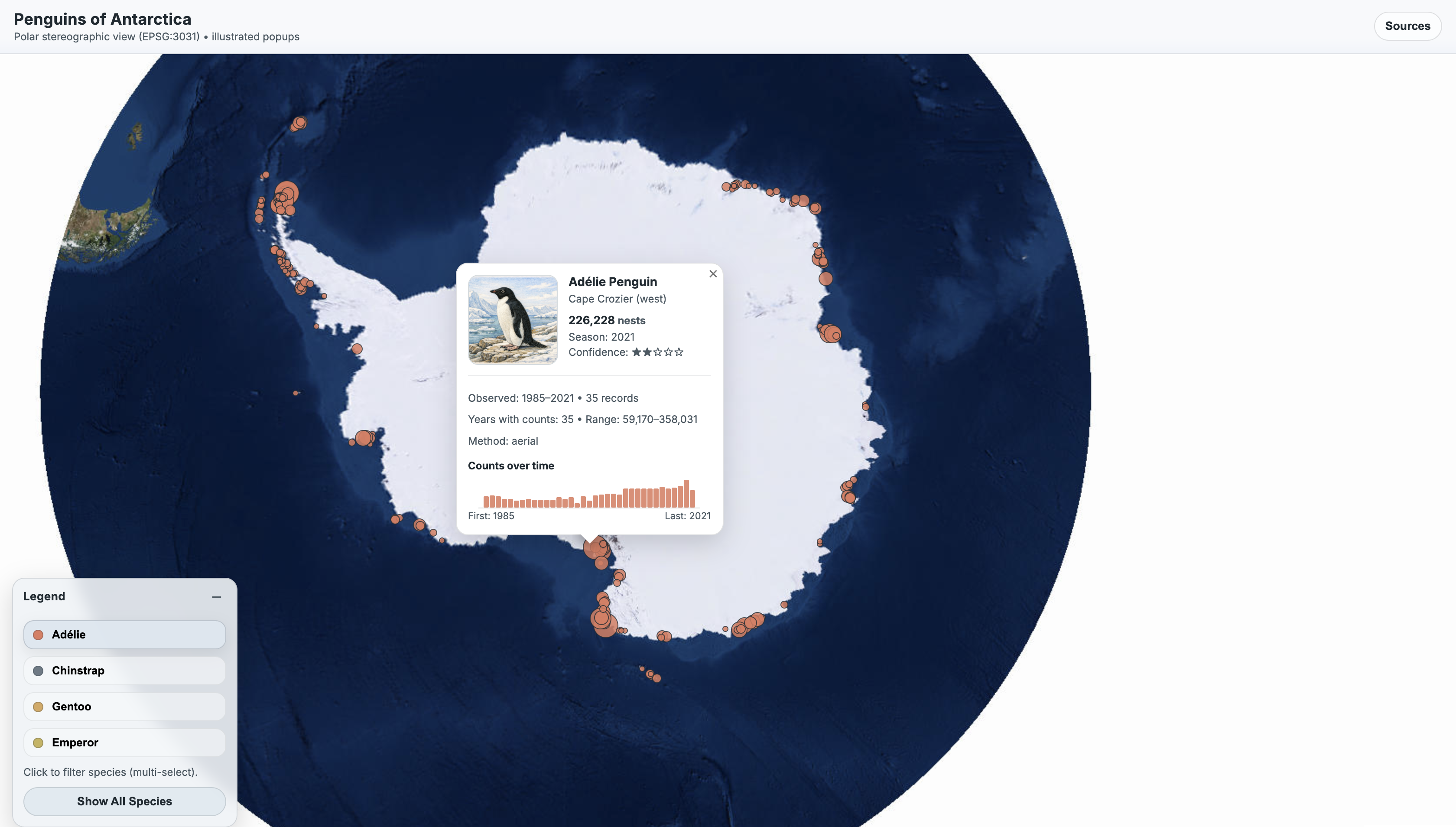
That is the heart of prompt cartography, at least as I see it. Prompt cartography is not about asking an LLM to make a map while the cartographer wanders off to make coffee. It is about learning how to think with these systems. It is about knowing what to ask, what to reject, what to revise, what to verify, and when to say, "Nope, that is nonsense, let's try again."
In other words, it is still cartography.
A cartographer using an LLM is not surrendering creativity any more than a cartographer using ArcGIS Pro, QGIS, Mapbox, Illustrator, a GPS receiver, or a JavaScript library has surrendered creativity. The creativity lies in the decisions: what to show, what to omit, what to emphasize, what to question, what to make legible, and what to make felt.
Technology changes the surface of the work. It changes the workflow. It changes who can participate. It changes what becomes easy, what becomes hard, and what becomes newly possible.
But it does not remove the human question.
What are you trying to say?
That question survives every tool.
The claim that "AI content cannot be creative" usually rests on a romantic idea of creativity as something untouched by mediation. A lonely human soul, summoning originality from some pure interior chamber, then pouring it directly into the world. It is a lovely image. It is also mostly nonsense.
Human creativity has always been mediated by materials, institutions, genres, tools, audiences, constraints, and prior work. Shakespeare had the stage. Beethoven had the piano. Tolkien had philology, mythology, maps, paper, and an almost suspicious tolerance for invented place names. Filmmakers have cameras. Designers have software. Cartographers have data, projections, symbol systems, and increasingly, prompts.
The tool does not erase the artist.
But it does reveal the artist's judgment.
That is why I think the blanket rejection of "AI content" is less a serious critique than a category error. It confuses origin with quality. It assumes that because a tool contributed to the production of a work, the work itself is automatically disqualified from being meaningful, creative, or worth engaging.
By that logic, most of human culture would be disqualified.
Now, there are real concerns here. AI can be used to flood the world with junk. It can launder plagiarism. It can flatten voice. It can reproduce bias. It can make mediocre work easier to produce at scale. These are not imaginary problems, and anyone pretending otherwise is selling something.
But those are arguments for better judgment, better ethics, better disclosure, better teaching, and better craft.
They are not arguments against creativity.
For people skeptical of prompt cartography, I would put it this way: you do not have to love AI. You do not have to use it for everything. You do not have to pretend the bad examples are good. Skepticism is healthy. In fact, skepticism is required.
But skepticism should be aimed at the work, the workflow, and the claims being made. Not at a vague category called "AI content," as if every human-machine collaboration were the same thing.
The future of creative work will not be divided neatly between "human-made" and "AI-made." That line is already blurry, and frankly, it has been blurry for a long time. The more useful distinction will be between work made with care and work made without it.
Prompt cartography, at its best, belongs in the first category.
Not because the machine is creative by itself.
Because a human being is still there, choosing, judging, revising, arguing, rejecting, shaping, and occasionally muttering at the screen when the LLM confidently invents something absurd.
Naturally.